We have seen it happen more times than we care to count: a contractor breaks ground on a slope in the Bathwick area, assumes the limestone will hold, and within days the excavation is a mess of water-charged clay and fractured rock. The geology of Bath is deceptive. You get that beautiful honey-coloured Great Oolite near the surface, but it sits directly on top of the Lias Clay — a formation that turns into a lubricated failure plane after a few weeks of rain. A proper soil mechanics study is not about ticking a building control box. It is about knowing, before you commit to a foundation design, whether you are dealing with competent rock, weathered shale, or a buried landslide deposit. The difference is measured in tens of thousands of pounds in re-design costs. When we run the triaxial cell and the oedometer on a Bath sample, we are looking for exactly that: the stress path that separates a straightforward job from a ground engineering headache. For deeper profiling, a CPT test can give us continuous stratigraphy in the alluvial clays near the Avon without the disturbance of drilling.
In Bath, the difference between a £3,000 site investigation and a £30,000 foundation repair is often knowing the shear strength of the Lias Clay at the exact depth of your proposed excavation.
Service characteristics in Bath
Critical ground factors in Bath
Bath's development history makes ground risk a first-order concern. The city did not just build on the flat valley floor; it climbed the slopes. Lansdown, Bear Flat, and Odd Down are all areas where historic construction — much of it pre-1920 — cut into the hillside without engineered retaining structures. Over a century later, those cuts are creeping. A soil mechanics study here has to answer a dual question: what are the in-situ properties of the natural ground, and what residual strength is available in any pre-existing shear surfaces? The 1994 landslide on the A36 at Limpley Stoke, just outside Bath, is a textbook example of Lias Clay failing along a pre-sheared plane after prolonged rainfall. Our lab programme for slope-side projects in Bath always includes ring shear testing for residual strength when site observations suggest previous movement. Ignoring this step because the borehole log says 'stiff clay' is exactly the sort of shortcut that leads to a failure during the next wet winter.
Our services
A soil mechanics study in Bath is only as good as the sampling and the testing programme designed around it. We do not run generic test suites — we design the lab schedule once we understand the geology and the proposed structure. Here is how we break it down.
Advanced Laboratory Testing Programme
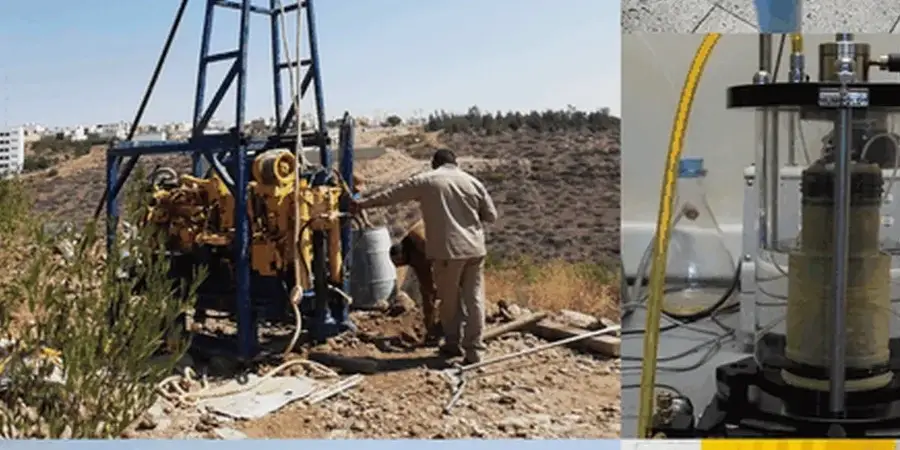
We run triaxial compression on 100 mm Shelby tube samples — consolidated undrained with pore pressure measurement (CUPP) for the Lias Clay, and drained (CD) for the granular Head deposits. Each test includes a saturation ramp to 400 kPa back pressure to ensure B-values above 0.95. Oedometer consolidation on 75 mm rings gives us mv and cv for settlement calculations. Point load testing on Oolite core supplements uniaxial compression for rock mass classification per BS 5930.
Ground Investigation Support and Interpretation
The lab data only makes sense when it is tied back to the ground model. We work directly with drilling crews operating dynamic sampling rigs and rotary coring on Bath's constrained-access sites — think back gardens in Widcombe with 1.2 m clearance. We provide the sample handling protocols (Class 1 to Class 5 per Eurocode 7) and produce the Geotechnical Design Report with characteristic values derived from the lab data, not just tabulated.
Quick answers
What does a soil mechanics study cost for a typical house extension in Bath?
For a single-storey rear extension on a Bath hillside, a targeted soil mechanics study including a window sampler borehole, laboratory classification (Atterberg, particle size, moisture content), sulphate and pH testing, and a factual report typically falls between £2,510 and £4,670. The range depends on access for the rig, depth to competent bearing strata, and whether consolidation or triaxial testing is required by Building Control.
Which soil tests are mandatory for Building Control approval in Bath?
Bath and North East Somerset Council generally requires a ground investigation report that satisfies BS 5930 and Eurocode 7. At minimum, this means classification tests (moisture content, Atterberg limits, particle size distribution) and chemical testing for sulphates and pH to BRE SD1 standards. If you are building near a slope or on made ground, consolidation and shear strength tests become essential — structural engineers cannot design safely without them.
How do you handle the Lias Clay shrinkage risk in Bath?
Lias Clay is a high-plasticity clay with a plasticity index often exceeding 30% here. We quantify the volume change potential using the modified plasticity index (I'p) method from the National House Building Council (NHBC) Standards. This involves Atterberg limits on samples taken at foundation depth, and in high-risk cases we run a shrink-swell test in the oedometer to measure the coefficient of volume change (mv) under seasonal moisture variation. The foundation depth is then set accordingly.
Can you test the strength of the Great Oolite before piling?
Absolutely. We test intact rock cores in a compression machine per BS 1377 or ISRM methods to get the unconfined compressive strength. For a more complete picture — especially when the rock is fractured or vuggy — we run point load index tests (Is50) on irregular lumps and convert them to UCS using the size correction factor. This data feeds directly into pile design parameters like end-bearing capacity and skin friction in weathered rock.