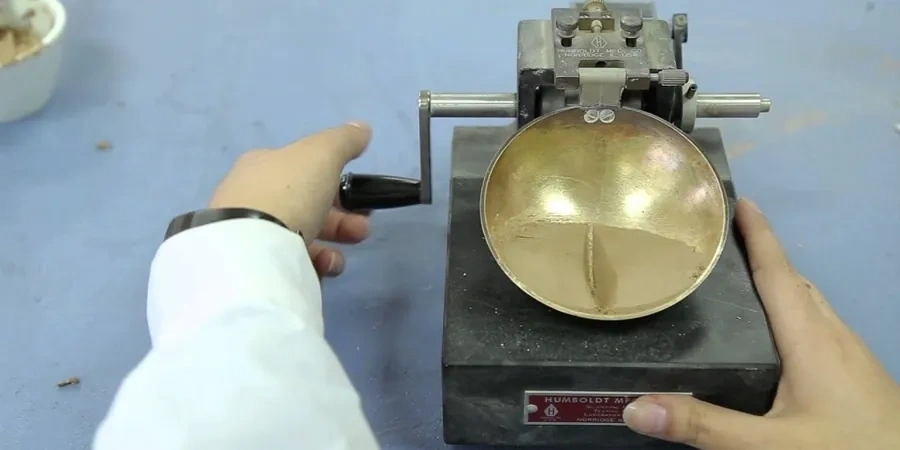
A common mistake on Bath construction sites is assuming all clay behaves the same. The city sits on a geological mosaic, from the stiff Jurassic clays of the higher elevations to the softer alluvial deposits along the River Avon. A contractor who skips Atterberg limits testing on a Combe Down site might find their subgrade turning to slurry after a wet winter. The plastic and liquid limits of the local Lias Clay dictate everything from excavation stability to pavement life. We see it repeatedly: a project runs over budget because the earthworks specification didn't match the actual plasticity of the ground. Our laboratory determines the liquid limit, plastic limit, and plasticity index in strict accordance with BS 5930, giving you the numbers to write a defensible earthworks specification. When the geology varies over short distances, as it does on Bath's famous seven hills, you need more than a generic desk study. You need precise index testing. For deeper strength profiling, the data pairs naturally with triaxial testing on undisturbed samples.
The plasticity index of a Bath clay doesn't just classify the soil; it predicts its shrinkage, swelling, and workability through the wet British winter.
Service characteristics in Bath
Critical ground factors in Bath
The risk profile of a foundation in Bathwick is fundamentally different from one on the slopes of Lansdown. Bathwick sits on river terrace gravels overlying Lias Clay, where a high water table can keep the clay at a liquidity index near one, meaning it behaves almost like a viscous fluid under load. Lansdown's geology includes the Inferior Oolite overlying Midford Sands, but the clay bands within the sequence can have plasticity indices exceeding 30 percent. A retaining wall designed without a measured PI for these bands is a candidate for long-term creep failure. The shrinkage potential of the clays, directly correlated to the plasticity index, can cause differential settlement in strip footings on the hillside. Ignoring the Atterberg limits on a brownfield site near the city centre, where made ground may contain reworked clays of completely different plasticity, introduces a variability that standard penetration tests alone cannot quantify. The laboratory test costs a fraction of the cost of a failed retaining wall or a heaved pavement.
Our services
Our Bath laboratory provides a complete index testing programme that integrates Atterberg limits with other classification tests for a full geotechnical description of the cohesive strata on your site.
Full Plasticity Suite
Liquid limit by cone penetrometer, plastic limit by thread-rolling, and calculated plasticity index, reported on the Casagrande chart with natural water content for liquidity index.
Combined Classification Packages
Atterberg limits paired with grain-size analysis by wet sieving and sedimentation, providing a complete particle size distribution and plasticity classification to BS 5930.
Shrinkage Limit and Linear Shrinkage
Determination of the shrinkage limit and linear shrinkage on remoulded samples, critical for assessing the volume change potential of clay soils in earthworks and embankment construction.
Quick answers
What does the Atterberg limits test cost in Bath?
For a standard determination of liquid limit, plastic limit, and natural water content on a single sample, the fee ranges from £60 to £80. Testing multiple samples from different depths or locations reduces the unit cost. We provide a firm quote based on the number of samples and the required turnaround time.
How long does the Atterberg limits test take from sample delivery?
The laboratory processing time is typically three to five working days from receipt of the sample. The soil must first be dried, gently disaggregated, and wet-sieved through the 425 µm sieve before the liquid and plastic limit determinations begin. A faster turnaround is available for urgent projects.
Can the plasticity index predict the swelling potential of clay under my foundation?
Yes, the plasticity index is a primary indicator of swelling and shrinkage potential. A PI above 25 percent indicates a high-plasticity clay with significant volume change potential. We use the standard correlations from BRE Digest 240 and the NHBC standards to classify the risk. The liquidity index, combining PI with the natural water content, gives an indication of the current state of the clay in the ground.