A contractor working on a hillside development near Lansdown Road hit a layer of fullers earth clay last autumn. The initial borehole logs looked fine, but the material behaved completely differently under load. What saved the foundation design was a multistage consolidated undrained triaxial test. In Bath, the geology shifts abruptly from the Great Oolite limestone plateaus to the valley fill clays of the Avon corridor. A standard bearing capacity check rarely tells the full story. Our team sees this pattern repeatedly on sites across the city. When you need to quantify effective cohesion and friction angle under controlled drainage conditions, the triaxial test is the benchmark. We often combine it with an spt drilling campaign to correlate in-situ blow counts with undisturbed lab specimens taken from the same borehole.
A well-executed triaxial test on Bath's Lias Clay can reveal a friction angle 3 to 5 degrees higher than conservative assumptions, directly reducing foundation costs.
Service characteristics in Bath
Live process video
Critical ground factors in Bath
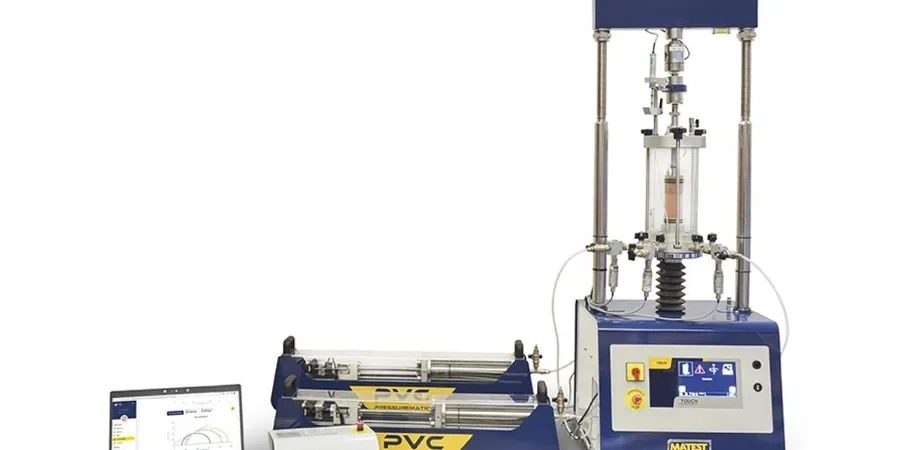
The triaxial cell itself is a compact but solid piece of equipment: a transparent acrylic cylinder clamped between a base pedestal and a top cap, housed inside a load frame that applies axial compression via a motorised piston. In our lab near Bath, the cell is filled with de-aired water and pressurised through a digital volume-pressure controller. A failure in the drainage line or a misaligned loading ram can invalidate a complete test sequence. The bigger risk, however, sits outside the laboratory. Disturbed samples taken from the Mercia Mudstone or the river terrace gravels near the Avon produce erratic stress-strain curves that look like a design parameter but are actually an artefact of poor sampling technique. That is why we insist on thin-walled Shelby tubes for cohesive soils and train the drilling crew specifically for the Bath geology.
Our services
Our Bath-based laboratory runs triaxial tests as part of a broader geotechnical testing programme, always aligned with the specific ground conditions found across the city.
Multistage Triaxial Testing
Three shearing stages on a single specimen, ideal for sites around Bath where intact core recovery is limited and multiple specimens cannot be obtained from the same depth. We use the method to define the complete failure envelope from a single undisturbed sample of Lias Clay or Fuller's Earth, reducing both cost and schedule impact.
Consolidated Drained Testing with Stress Path Control
For embankment works and long-term cut slope analysis on the hillside developments common in Bath, drained strength parameters are critical. Our CD triaxial system runs low shear rates with continuous pore pressure monitoring, delivering reliable effective stress parameters for use in limit equilibrium slope models.
Quick answers
What is the typical turnaround time for a triaxial test programme in Bath?
A standard set of three CU triaxial tests on cohesive soil takes between 10 and 14 working days from sample receipt to report. Consolidated drained tests require longer shearing phases and may extend the schedule to 15-20 working days. We can accommodate faster turnaround for urgent projects if agreed in advance.
How much does a triaxial test programme cost in Bath?
A three-specimen multistage CU triaxial test programme typically ranges from £1,590 to £2,030, depending on the number of confining stages per specimen and whether drained or undrained conditions are specified. The final cost depends on the soil type, specimen preparation difficulty, and reporting requirements.
Can you test the Mercia Mudstone found in parts of Bath?
Yes, Mercia Mudstone can be tested, but sample preparation requires careful trimming due to its fissile nature. We typically run multistage CU tests on this material because obtaining multiple identical specimens from a single core run is rarely possible. The siltstone bands within the mudstone sequence may require larger 70 mm or 100 mm diameter specimens.
Do you provide effective stress parameters for slope stability analysis?
Absolutely. Consolidated drained tests with pore pressure measurement deliver the effective cohesion (c') and effective friction angle (φ') needed for limit equilibrium slope models. For the overconsolidated clays on Bath's hillsides, we also report the peak and residual strength envelopes where relevant.
Is your laboratory accredited for triaxial testing to British Standards?
Our laboratory operates under a quality management system aligned with ISO/IEC 17025 and performs all triaxial tests in accordance with BS 1377 parts 7 and 8, BS 5930, and the relevant clauses of Eurocode 7. Calibration of load cells, pressure transducers, and displacement sensors is maintained on a regular schedule with traceable reference standards.