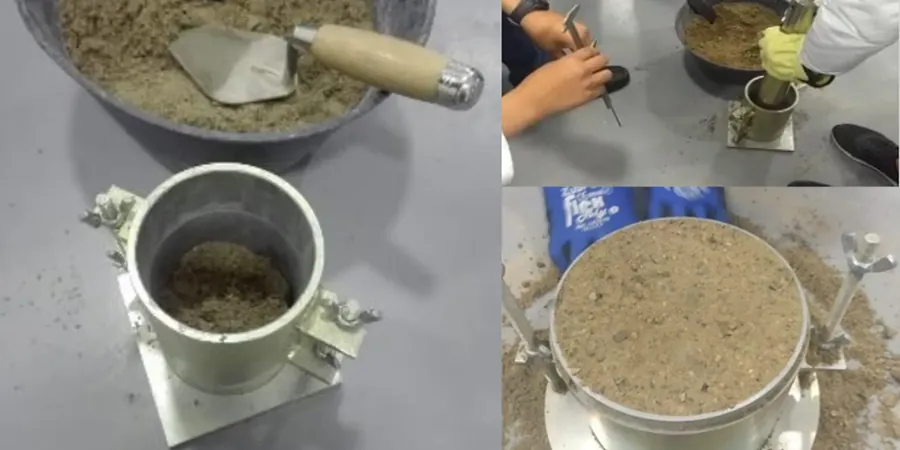
The mechanical hammer in the lab drops with a rhythmic thud, compacting the Bath soil sample in layers inside a standard mould. This is the Proctor test, a fundamental procedure for determining the relationship between moisture content and dry density of a soil. In Bath, where the geology shifts dramatically between the limestone of the Cotswold edge and the alluvial clays of the Avon Valley, understanding this compaction curve is non-negotiable. The test tells the site team exactly how much water to add and how much compactive effort to apply to achieve a stable subgrade. Our laboratory runs both the 2.5 kg and 4.5 kg rammer methods, tailoring the approach to the specific material—whether it is a well-graded gravel from a Lansdown Road project or a silty clay from a site near the River Avon. This data feeds directly into the CBR road design process and is often paired with sand cone density checks during construction to verify that the field compaction meets the laboratory benchmark.
The Proctor curve is not just a lab chart; it is the compaction specification for the ground beneath every road and building in Bath.
Service characteristics in Bath
Critical ground factors in Bath
The variable geology of Bath creates a contrast that directly impacts compaction. On the northern slopes, you have freely draining limestone brash; in the valley floor, you have thick, moisture-sensitive Lias Clay. This means a single compaction specification for a city-wide project is almost always inadequate. Over-compacting a wet clay in the valley can lead to shear failure within the fill, creating a layer that is weaker than the surrounding soil, not stronger. Conversely, under-compacting a dry, granular fill on the hillsides leaves a honeycomb structure prone to collapse under the first heavy rainfall. The Bath climate, with its high annual rainfall averaging around 800 mm, means the OMC determined in the lab is a moving target in the field. Our reports provide a sensitivity analysis around the optimum, showing the allowable moisture range for achieving 95% relative compaction, so site engineers can make informed decisions even when the weather turns against them.
Our services
Our compaction testing services in Bath are designed to support both the design phase and the construction quality assurance phase of your project. We work with local ground investigation companies and directly with main contractors to deliver reliable data.
Standard Proctor (Light Compaction)
Using the 2.5 kg rammer, this test is suitable for general fill, landscaping, and subgrade evaluation for lightly loaded pavements. It provides the baseline MDD and OMC for fine-grained soils commonly encountered in Bath's residential developments.
Modified Proctor (Heavy Compaction)
Employing the 4.5 kg rammer with a higher drop, this test simulates the compactive effort of modern heavy vibratory rollers. It is the standard reference for highway embankments, commercial building pads, and airfield pavements where a higher bearing capacity is critical.
Quick answers
What is the difference between the Standard and Modified Proctor test?
The Standard Proctor uses a 2.5 kg rammer dropped 300 mm, compacting the soil in three layers. The Modified Proctor uses a 4.5 kg rammer dropped 450 mm, compacting in five layers (in the large mould). These differences in compactive effort simulate different types of site plant: a smooth-wheeled roller for standard effort versus a heavy vibratory roller for modified effort. The Modified test always results in a higher maximum dry density and a lower optimum moisture content for the same soil.
How much does a Proctor test cost in the Bath area?
For a single-point Proctor test (Standard or Modified) in the Bath area, the cost typically ranges from £70 to £160, depending on the material type and whether oversize corrections are needed for coarse particles. A full five-point curve, which provides the complete moisture-density relationship, is at the higher end of this range due to the additional lab work involved.
Can you test the limestone brash from our Bath site?
Yes, we can. The Oolitic limestone brash common around Bath often contains coarse particles. We follow BS 1377 procedures for oversize material, which involves sieving out particles larger than 37.5 mm and applying a mathematical correction to the measured density. This ensures the reported MDD is representative of the bulk fill material, not just the fine fraction.
How is the Proctor result used on a construction site?
The lab result gives you the target maximum dry density (MDD) and optimum moisture content (OMC). On site, a nuclear density gauge or sand replacement test measures the in-place dry density and moisture content. The ratio of the field density to the lab MDD, expressed as a percentage, is the relative compaction. Most specifications in Bath require at least 95% relative compaction for structural fill, with the moisture content within ±2% of the OMC.