Bath sits in a steep-sided valley carved by the River Avon, with elevations jumping from 20 m to over 200 m across the city. That topography creates serious bearing capacity challenges for any structure. Three out of four sites we assess in Bath need some form of ground improvement or deepened formation before a conventional [shallow foundation design] can work. The local geology flips between Great Oolite limestone, Fuller’s Earth clay, and deep pockets of made ground left by Roman and Georgian quarrying. We deal with this every week. Before committing to a pad or strip layout, we cross-check the desk study against test pits excavated to 4.5 m to confirm refusal depth and the presence of solution features in the limestone. Getting the foundation level wrong here means differential settlement within months, not decades.
Bath’s limestone dissolves. We treat every site within 100 m of a mapped quarry as a potential sinkhole risk until boreholes prove otherwise.
Service characteristics in Bath
Critical ground factors in Bath
A developer we worked with on Upper Lansdown Mews ignored the preliminary [shallow foundation design] recommendation to deepen the strip footings through 1.2 m of Victorian ash fill. The ground-bearing slab was poured directly onto the fill in August, and by November the rear extension had settled 22 mm, cracking the stone cladding at the party wall junction. The repair involved needle-beam underpinning and cost three times the original foundation budget. Bath is full of these buried surprises: backfilled cellars, infilled quarry pits, and soft alluvium lenses where the Avon meandered before the canal was built. The risk compounds when the site slopes, because a shallow slide in the weathered zone can mobilize on a clay seam after heavy rain. Our design reports always include a groundwater observation log and a slope stability commentary if the gradient exceeds 1:6, because insurers now ask for that before issuing latent defects cover on new builds within the conservation area.
Our services
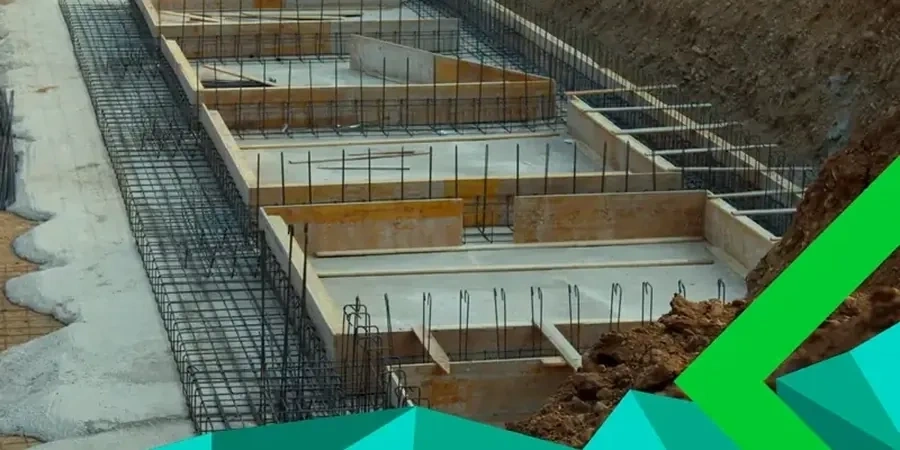
We provide three levels of [shallow foundation design] service tailored to the site conditions common in Bath: from standard residential pads to complex raft solutions on marginal ground.
Pad and Strip Foundation Design
Dimensioned layouts for masonry and framed structures up to three storeys on competent limestone or stiff clay. Includes bearing capacity calculation, settlement analysis, and formation level specification with a site-specific ground investigation report.
Raft Foundation Design on Soft Ground
Reinforced concrete rafts designed for sites on alluvium or made ground where strip footings would exceed 2.5 m width. We model soil-structure interaction using modulus of subgrade reaction values back-calculated from plate load tests or SPT correlations.
Foundation Remediation and Underpinning Design
Assessment of existing shallow foundations showing distress, with underpinning schemes designed to transfer load to a deeper competent stratum. Common in Bath where historic structures sit on deteriorating timber grillages or shallow stone footings.
Quick answers
How much does a shallow foundation design cost for a typical house extension in Bath?
For a single-storey rear extension on a standard Bath terraced plot, the design package including ground investigation, bearing capacity calculation, and a dimensioned foundation layout typically falls between £1,480 and £2,400. The final figure depends on access for the drilling rig and whether laboratory testing on recovered samples is needed to satisfy Building Control.
Do I need a ground investigation before shallow foundation design in Bath?
Absolutely. Bath Building Control will not approve a foundation design without site-specific ground data. The local geology varies too much to rely on desk studies alone. We typically specify two trial pits or one cable percussion borehole to 4.5 m depth, with laboratory classification and strength tests on any cohesive layers encountered.
What foundation depth is required to avoid frost action in Bath?
BS EN 1997-1 and the approved document to Part A of the Building Regulations recommend a minimum formation depth of 0.45 m for frost protection in the UK, but in Bath we usually specify 0.90 m to get below the zone of seasonal moisture variation in the clay. On sloping sites we go deeper on the downhill side to maintain a consistent bearing stratum.
Can you design shallow foundations on made ground in central Bath?
It depends on the fill composition and depth. If the made ground is less than 1.5 m thick and overlies competent limestone, we can design a reinforced strip footing that bridges the fill and bears on the rock. If the fill is deeper or contains organic material, we switch to a raft or consider ground improvement. We never place foundations on undocumented fill without proving the underlying strata first.