Bath's UNESCO World Heritage status, combined with its position in the Avon Valley where elevations can differ by over 200 metres within the city boundary, creates a unique set of constraints for any substructure. The variable geology here, transitioning from the Great Oolite limestone of the Cotswold escarpment to the softer Lias clays of the valley floor, demands a pile foundation design approach that is both technically rigorous and sensitive to the urban fabric. A generic solution simply will not work. Our team integrates a detailed understanding of the local stratigraphy, including the notoriously variable depth to competent bedrock across the city, to develop deep foundation schemes that transfer structural loads past the weaker near-surface deposits. Before committing to a piling strategy, it is often prudent to characterise the ground with a targeted test pit investigation to visually inspect the made ground and shallow strata that are ubiquitous in Bath's historic core.
Effective pile design in Bath hinges on correctly interpreting the rapid lateral changes in the Lias Clay and Oolite Limestone interface, a feature that defines the city's geotechnical character.
Service characteristics in Bath
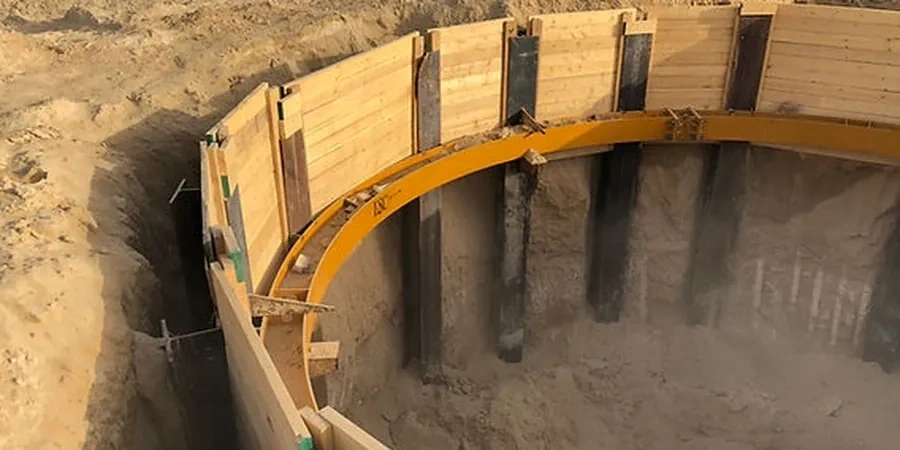
Critical ground factors in Bath
BS 5930 and Eurocode 7 are particularly pertinent in Bath because of the prevalence of historic fill, undocumented basements, and the risk of encountering solution features within the limestone. A pile foundation design that does not account for these anomalies can lead to significant construction delays and cost overruns. The primary risk is differential settlement arising from a misinterpretation of the rockhead profile, where a thin limestone ledge might be mistaken for a massive, competent stratum. Furthermore, the Lias Clay, while often stiff, can be prone to softening and swelling when exposed to water, affecting the long-term shaft friction of bored piles. Our methodology mitigates this by specifying rigorous socket lengths into the proven bedrock and, where necessary, employing permanent casing through the weathered zone to guarantee the integrity of the load transfer mechanism.
Our services
Our pile foundation design service in Bath covers the complete development cycle, from desk study through to construction supervision, always tailored to the specific geotechnical and logistical constraints of the site.
Geotechnical Interpretative Reports
We synthesize data from boreholes, CPTs, and laboratory testing into a clear ground model for Bath's complex geology, defining the engineering parameters needed for pile design.
Axial Capacity and Settlement Analysis
Detailed calculations of pile capacity under compression and tension, including t-z analysis for settlement prediction, ensuring compliance with serviceability requirements for sensitive structures.
Pile Load Test Specification
Design and supervision of static and dynamic load testing programs to validate the design assumptions and confirm pile performance on site.
Value Engineering and Pile Optimization
Reviewing piling layouts, diameters, and lengths to reduce material quantities and installation time without compromising safety, often yielding significant savings on Bath projects with difficult access.
Quick answers
How does the variable geology in Bath affect the choice between bored and driven piles?
Driven piles can be problematic in the city centre due to vibration risks to heritage buildings and the potential for refusal on shallow limestone obstructions. Bored or CFA piles are often preferred as they can be drilled through the made ground and Lias Clay to socket into the Great Oolite, providing a high-capacity solution with minimal disturbance. The final choice depends on a thorough ground investigation per BS 5930 to map the bedrock profile accurately.
What is the typical cost range for a pile foundation design package for a residential project in Bath?
For a standard residential project, the design package including the interpretative report, pile schedule, and calculations typically falls between £1,220 and £4,610, depending on the complexity of the ground conditions and the number of piles required.