Bath's celebrated Georgian architecture rests on a geological puzzle that shifts dramatically from one street to the next. Builders working on the slopes of Lansdown face a completely different set of ground conditions compared to those excavating near the River Avon, where alluvial clays and buried river channels dominate. Before any foundation or retaining structure is designed, a precise picture of the subsurface is non-negotiable. SPT testing provides that picture by measuring the resistance of soil layers to a standardized penetrometer, yielding N-values that directly inform bearing capacity calculations under Eurocode 7. Our technical team executes these tests in accordance with BS 5930 and BS EN 1997-2, adapting the drilling approach to whether the site sits on the Great Oolite limestone or within the valley's soft, saturated silts. For deeper profiling where a continuous record is needed, the data from SPT boreholes is often correlated with a CPT test to refine the stratigraphic model across transitional ground.
An SPT N-value of 30 in Bath's limestone-derived clays can indicate a stiff consistency, but the same blow count in the Avon gravels signals a dense granular deposit: geological context transforms a number into a design parameter.
Service characteristics in Bath
Critical ground factors in Bath
A site in the flat floodplain of Twerton presents a markedly different risk profile from a hillside plot in Widcombe. In Twerton, the water table is often within two metres of the surface, and the soft alluvial clays can lose significant strength when disturbed. An SPT N-value below 4 at foundation level here would trigger a review of deep foundation options or ground improvement. Conversely, on Widcombe's slopes, the risk shifts to the presence of shallow, steeply dipping limestone beds with potential for instability. Over-reliance on a single borehole in this setting is dangerous; lateral variability is the norm, not the exception. An erratic sequence of refusal on limestone followed by a drop to N=12 in a clay-filled fissure is a classic Bath signature. Ignoring such a transition during the slope stability assessment could lead to a retaining structure being founded on material with inadequate passive resistance, a mistake that becomes expensive to rectify once excavation is underway.
Our services
Our Bath-based SPT service is structured to provide the specific data points that structural and civil engineers require for design. The programmes are designed to suit the scale of the project and the complexity of the anticipated ground profile.
Borehole Drilling and SPT Sampling
Execution of SPTs at 1.5 m intervals or at changes of stratum, using cable tool or rotary drilling with casing to maintain borehole stability through Bath's mixed soils and weak rock.
N-value Correction and Geotechnical Report
Application of overburden, hammer energy, and borehole diameter corrections to deliver N60 values, accompanied by a factual report with soil descriptions logged to BS 5930.
Correlation for Foundation Design
Translation of SPT results into allowable bearing pressures and settlement estimates for shallow footings in the Bath area, referencing industry correlations and local experience.
Supplementary Laboratory Testing
Coordination of disturbed and undisturbed sample recovery for index testing, including particle size distribution and Atterberg limits, to validate field descriptions and input into design models.
Quick answers
How many boreholes with SPT are needed for a typical house extension in Bath?
For a domestic extension, the usual recommendation is a minimum of two boreholes positioned to capture any variation across the footprint. In Bath, this is particularly important where the site slopes or where historical maps indicate a former quarry or infilled ground. Each borehole would include SPTs at regular depth intervals, typically every 1.5 metres, continuing to a depth where competent ground is confirmed. The exact number and depth are finalised after a desk study of the site's geological setting.
What does SPT testing cost for a project in the Bath area?
For a standard programme of two to three boreholes with SPT sampling at the required intervals, the cost typically falls between £400 and £680 per borehole. The final figure depends on access conditions, depth of investigation, and whether the ground requires casing through unstable superficial deposits. This is the cost for the fieldwork, sampling, and the factual report; supplementary laboratory testing and a full interpretative design report are quoted separately based on the engineer's requirements.
How do you correct SPT N-values for the Bath limestone influence?
In the transition zones where the Bath Oolite is weathered near the surface, the split-spoon may encounter a mixture of stiff clay and limestone fragments. We correct the raw N-value for overburden pressure and hammer energy efficiency to obtain N60. In these mixed-face conditions, the results are reported with a detailed description of the recovered material, noting the percentage of gravel and cobble-sized rock fragments, so the design engineer can judge whether the corrected N-value is representative of a soil-like mass or is artificially elevated by rock inclusions.
Can SPT testing be done on a sloped site in Bath without a large drilling rig?
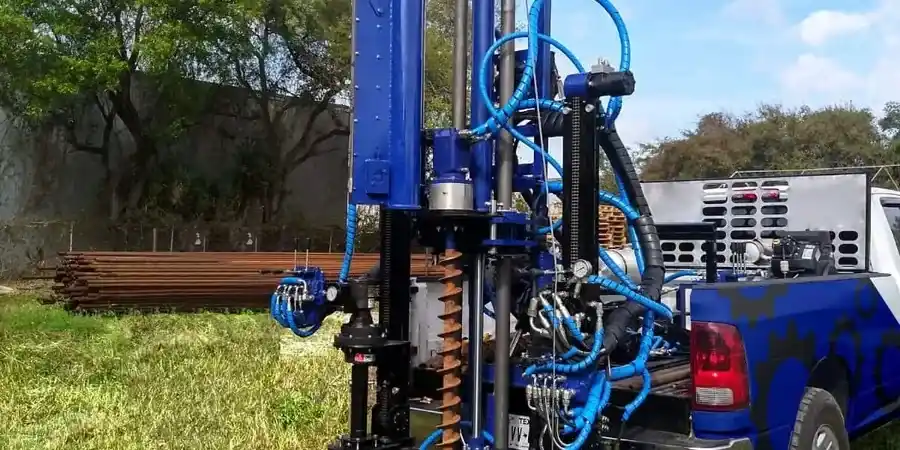
Yes, access to many of Bath's hillside properties is restricted. We use portable or tracked drilling rigs that can be manoeuvred onto terraced gardens and narrow lanes. On steeper gradients, the setup includes working platforms if required, and the borehole is drilled vertically with careful attention to the rod alignment. The SPT procedure remains identical to a flat site, but the report includes topographic context so the vertical depth is correctly interpreted relative to the slope geometry.