The geology of Bath divides construction practice sharply between the north and south slopes of the Avon valley. On the southern side, projects encounter the Great Oolite limestone—competent but heavily jointed, demanding active anchor design that locks into sound rock beyond weathered zones. North of the river, the Charmouth Mudstone and Lias Clay dominate, where passive anchors mobilising resistance through grout-to-ground bond in overconsolidated clay require a different design philosophy. A retaining wall in Widcombe faces different load transfer mechanisms than one in Larkhall, and anchor design must reflect that. The presence of the Bath Thermal Springs—rising along the Pennyquick Fault—adds groundwater chemistry variables that influence tendon protection grade selection. Our technical team applies BS 8081 and Eurocode 7 design approaches tailored to each slope and soil profile. For sites where rockhead is deep or variable, we often recommend combining anchor design with an exploratory rotary drilling campaign to map the interface between made ground, Lias Clay, and the underlying Carboniferous limestone before finalising free and fixed lengths.
Anchor design in Bath is a negotiation between the stiff limestone that provides excellent bond and the creeping Lias Clay that demands conservative free-length detailing.
Service characteristics in Bath
Critical ground factors in Bath
Bath's combination of steep valley sides, centuries-old retaining walls, and variable groundwater chemistry creates anchor design risks that are easy to underestimate. Thermal spring water carries dissolved sulphates and carbonates that accelerate steel corrosion—selecting the wrong protection class here means tendon failure within a decade. Overconsolidated Lias Clay exhibits time-dependent creep; passive anchors designed without allowance for relaxation can lose 20–30% of their load capacity within the first five years. The proximity of listed buildings on shallow strip footings demands that anchor installation methods be low-vibration and that grout pressures be limited to avoid heave beneath historic masonry. On sites within the Bath World Heritage Site boundary, visual impact restrictions may dictate flush anchor heads and recessed bearing plates. Each of these factors—corrosion, creep, vibration limits, aesthetic constraints—must be addressed explicitly in the design documentation submitted for building control approval under the Bath & North East Somerset Council.
Our services
Anchor design services in Bath span temporary excavation support for basement construction to permanent retention of highway cuttings. The three core service packages below cover the typical project spectrum encountered across the city's varied geology.
Active anchor design for deep excavations
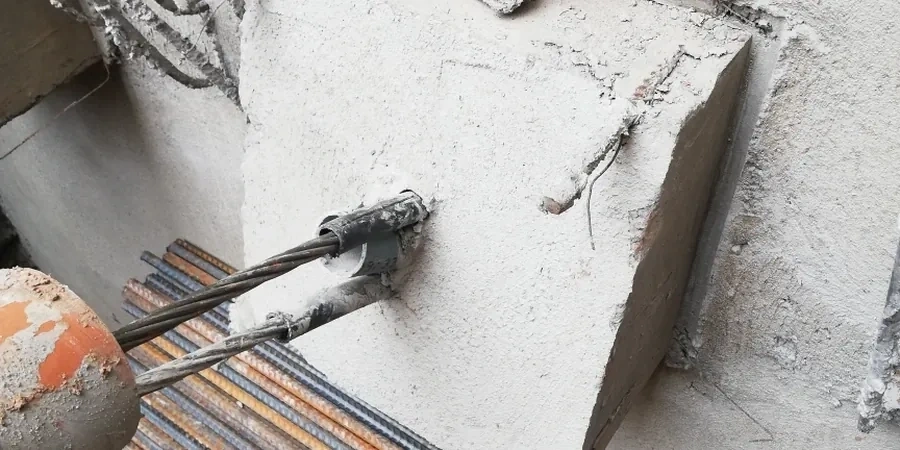
Prestressed strand or bar anchors for basement excavations and retaining walls where lateral displacement must be minimised to protect adjacent structures. Includes staged stressing sequences and locked-off load verification per BS EN 1537.
Passive anchor and soil nail design
Self-drilling and hollow bar passive anchors for slope stabilisation in Lias Clay cuttings and embankment reinforcement. Design accounts for creep relaxation in overconsolidated soils and long-term bond degradation in weathered zones.
Anchor corrosion protection and durability assessment
Protection class selection (I or II) based on site-specific groundwater chemistry analysis. Particularly relevant near the Bath thermal springs, where sulphate and chloride levels exceed typical UK groundwater values and drive the need for double corrosion protection systems.
Quick answers
What is the difference between active and passive ground anchors?
Active anchors are prestressed after installation: a tensile force is applied via hydraulic jack and the load is locked off against the anchor head, actively compressing the retained ground or structure. They control displacement from the outset. Passive anchors develop resistance only when the ground deforms sufficiently to mobilise the bond stress along the fixed length—they do not receive a prestress load. In Bath, active anchors are preferred where movement must be minimised, such as retaining walls adjacent to listed buildings; passive anchors suit slope stabilisation where some deformation is acceptable.
How do Bath's geology and thermal springs affect anchor design?
The Great Oolite limestone on the south side of the Avon provides excellent bond capacity but contains solution features and open joints that can cause grout loss during installation. The Lias Clay on the north slopes exhibits low shear strength in weathered zones and long-term creep that relaxes passive anchor loads. The thermal springs introduce elevated sulphate and carbonate concentrations, requiring double corrosion protection (Class II per BS 8081) for permanent anchors within the spring influence zone. All three factors demand site-specific ground investigation before finalising anchor geometry and protection grade.
What tests are required for anchor acceptance?
BS EN 1537:2013 specifies three test categories. Investigation tests on sacrificial anchors confirm the ultimate bond capacity and validate the design assumptions. Suitability tests on working anchors (at least one per anchor type and stratum) apply 1.25 × the design load and monitor creep over a 15-minute hold period. Acceptance tests on every production anchor confirm correct installation and load transfer—typically 1.25 × working load with a 15-minute hold and creep monitoring. In Bath's Lias Clay, creep rate criteria are particularly stringent given the time-dependent behaviour of overconsolidated clays.
What is the typical cost range for anchor design and testing in Bath?
Anchor design and testing costs in Bath typically range from £770 to £3,250, depending on the number of anchors, the complexity of the ground conditions, and the testing regime required. A single investigation anchor in limestone with full instrumentation sits at the upper end of that range. A straightforward passive anchor design for a small slope stabilisation project, with suitability and acceptance testing on a few anchors, aligns with the lower end. Each quotation is project-specific and reflects the testing requirements of BS EN 1537.
What design life do ground anchors in Bath require?
Permanent anchors in Bath are typically designed for a 60-year service life, consistent with BS 8081 recommendations and the requirements of Bath & North East Somerset Council for retaining structures. This demands double corrosion protection, grout integrity testing, and long-term creep allowances for anchors in Lias Clay. Temporary anchors for excavation support are designed for a 2-year life and can use single corrosion protection, provided they are decommissioned or cut after the works are complete. The design life drives material choices: epoxy-coated strand, corrugated sheathing, and cement grout with low water-cement ratios are standard for permanent installations.