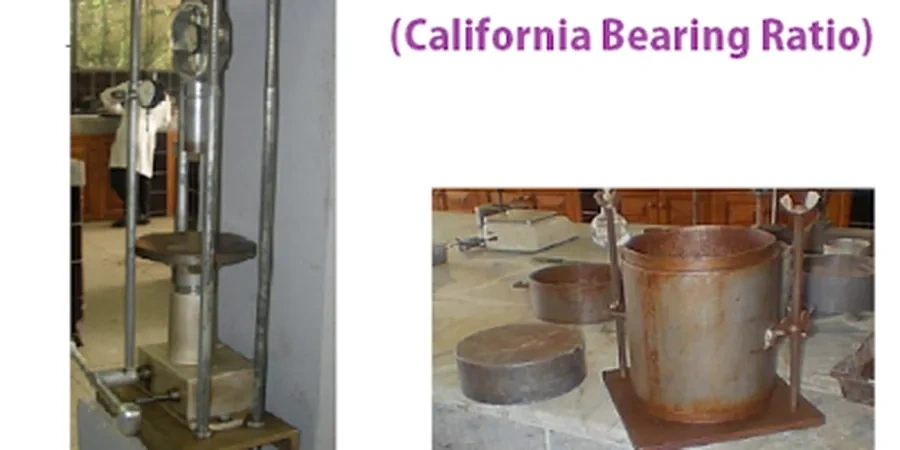
The compression machine hums quietly in our lab as the 50 kN plunger drives into a compacted Bath soil sample at 1.27 mm per minute. That steady penetration, measured to the hundredth of a millimetre, is the heart of every laboratory CBR test we run. Bath sits on a geological jigsaw of Jurassic limestone, Fuller’s Earth, and river terrace gravels, and subgrade strength can swing wildly from one postcode to another. A soaked CBR of 2% in the Lias Clay near Weston will demand a completely different pavement design to the 8% you might get from the well-drained gravels out towards Lansdown. The test pits we dig to retrieve bulk samples tell half the story; the laboratory CBR test under controlled moisture and density conditions gives you the repeatable numbers your pavement engineer actually needs. We run both the standard 2.5 mm and 5.0 mm penetration readings, always checking against the force-penetration curve for origin correction, because a rogue zero error can inflate a CBR value by 30% if nobody’s watching.
A soaked CBR value below 2.5% in Bath’s Lias Clay means capping layers are mandatory, no negotiation with the pavement design.
Service characteristics in Bath
Live process video
Critical ground factors in Bath
A pavement job on the A4 near Batheaston taught us a hard lesson about skipping the soaked CBR. The contractor had a design based on an unsoaked 6% CBR from a quick on-site check, but the subgrade was Fuller’s Earth clay. After a wet winter, the formation softened to a CBR of barely 1.5%, and the asphalt cracked within eighteen months. The remedial capping layer cost triple what the proper laboratory CBR test would have. In Bath, where the water table rises fast in the valley bottom and many roads sit on low-permeability clays, the soaked laboratory CBR test is your insurance policy against post-construction softening. We’ve seen similar failures on residential estates in Odd Down, where builders assumed gravelly head deposits would drain freely, but perched water tables sat for weeks after heavy rain. A laboratory CBR test with the full soak cycle would have flagged the strength loss before the first lorry of Type 1 arrived. If your formation includes any material with more than 15% passing the 63-micron sieve, do not skip the soak.
Our services
Our Bath laboratory handles the full preparation chain for CBR testing, from sample extrusion to final reporting. We work with three standard service levels depending on what stage your project is at.
Single-Point CBR Determination
One compaction point, one soak, one penetration run. Suitable for small residential drives, footpath subgrades, or spot checks where the ground conditions are already well characterised and you just need a confirmatory value for the design capping thickness.
Three-Point CBR Family
Three moulds compacted at different moisture contents bracketing optimum. We plot the full dry density versus CBR curve so you can see how sensitive the formation is to placement moisture. Essential for road schemes where the contractor needs a compaction window on site.
Stabilised CBR Package
For lime- or cement-treated subgrades, we follow BS 1924-2 with accelerated curing at 20°C or 40°C. We’ll test after 7 and 28 days of sealed curing, reporting the CBR gain and swell reduction. Frequently requested for brownfield redevelopment sites in Bath where in-situ stabilisation is in the remediation strategy.
Quick answers
How much does a laboratory CBR test cost in Bath?
A single-point soaked CBR test in our Bath facility runs between £100 and £190 per mould, depending on whether you need the full Proctor compaction family alongside it. A three-point CBR family with the associated moisture-density relationship typically falls in the upper end of that range per point. We quote firm prices after seeing the material type and knowing how much sample preparation is involved.
How long does the laboratory CBR test take?
From sample receipt to report, allow six working days for a soaked CBR. Four days are the soak itself, then one day for the penetration run and data reduction, plus a final day for technical review and report signing. We can expedite to four days if you bring the sample in first thing Monday and we compact it immediately, but the soak duration is fixed by BS 1377 and cannot be shortened.
Can you test stabilised or cement-bound materials for CBR?
Yes, we run CBR on hydraulically bound materials following BS 1924-2. The procedure differs from the standard BS 1377 method because the specimen cures sealed at a controlled temperature before soaking. We typically test at 7 and 28 days of curing, and we measure both the strength gain and the reduction in swell compared to the untreated control sample.
What is the difference between soaked and unsoaked CBR, and which one should I specify in Bath?
Soaked CBR simulates the worst-case subgrade condition after prolonged saturation, which is the standard assumption for UK pavement design per the MCHW. Unsoaked CBR tests the material at its compaction moisture content. In Bath, where winter groundwater levels rise significantly in the Avon valley and many subgrades are low-permeability clays, the soaked value is almost always the appropriate one for design. Unsoaked values can be dangerously optimistic.
How much sample material do you need for a laboratory CBR test?
For one three-point CBR family we need about 25 kg of disturbed bulk sample, bagged and sealed on site to preserve the natural moisture content. If the material is granular and free-draining we can work with less, but for cohesive clays the full 25 kg gives us enough to run the Proctor compaction, the CBR moulds, and moisture content checks without running short.