Specifying a soakaway depth in Bath without a Lefranc test is a gamble that backfires the moment the first heavy rainfall hits. We have seen attenuation tanks installed in what looked like competent limestone only to find they sat directly above a fissured zone draining into the Avon valley within hours. The local geology here is deceptive: the Great Oolite and Inferior Oolite formations that underpin much of the city are riddled with solution features, cavities, and variable joint spacing that make desk-study permeability assumptions worthless for infiltration design. Our team runs both the Lefranc test in soil and weathered horizons and the Lugeon test in bedrock boreholes to quantify hydraulic conductivity under the exact groundwater conditions present on your site, feeding directly into drainage strategies that satisfy Lead Local Flood Authority requirements for Bath and North East Somerset.
A single Lugeon test in fractured Bath stone can reveal a 100-fold permeability contrast across less than two metres of borehole depth.
Service characteristics in Bath
Critical ground factors in Bath
Bath’s position along the river corridor creates a permeability regime that shifts dramatically with season and elevation. The water table in the alluvial gravels near Green Park can sit within 1.5 metres of ground level during winter, while the limestone plateaux around Lansdown may remain unsaturated across the full investigation depth even after prolonged rainfall. Performing a permeability test in partially saturated rock without recognising the influence of air entrapment on flow readings produces Lugeon values that underestimate the true mass hydraulic conductivity by a factor of three or more. We counter this by extending pre-test saturation periods and running at least one repeat cycle at the target pressure to check for stabilisation. In flood-risk zones along the Avon, where Environment Agency consent conditions often require demonstrating that infiltration will not exacerbate off-site groundwater levels, the difference between a 2-litre and a 20-litre per minute acceptance rate can determine whether a project proceeds to construction or returns to redesign. Complementing the permeability campaign with a slope stability assessment is standard practice where deep drainage will alter pore-pressure regimes in the valley-side colluvium.
Our services
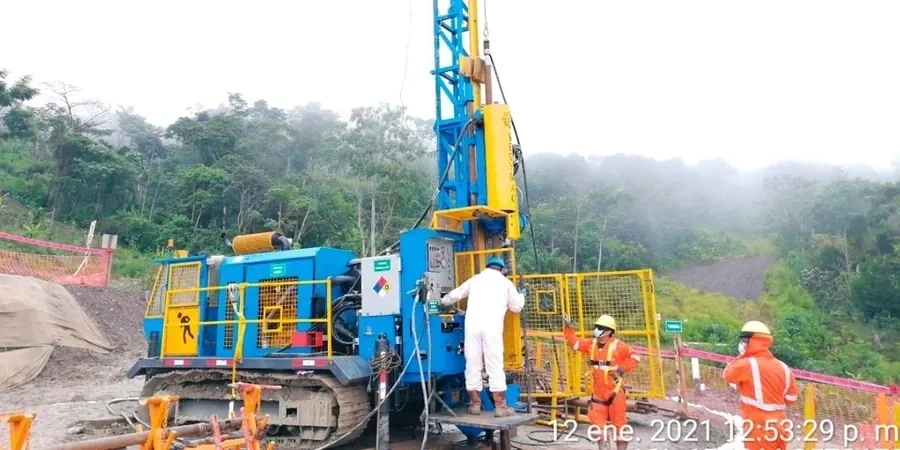
Our Bath team delivers the complete permeability investigation sequence, from borehole drilling through packer testing to geotechnical interpretation and drainage design input.
Borehole Lefranc testing
Variable-head and constant-head tests in soil and weathered rock, with test section isolation via pneumatic packer. Includes pre-test slug testing to determine appropriate flow rate and duration parameters.
Lugeon packer testing in bedrock
Five-stage pressure testing in NQ and PQ boreholes, interpreted using Houlsby’s method to classify fracture aperture, infilling, and dilation behaviour. Acoustic televiewer logging often paired to correlate flow zones with fracture orientation.
Soakaway infiltration rate reporting
BRE Digest 365-compliant calculations converting field permeability to design infiltration rates, with groundwater mounding analysis where multiple soakaways are proposed in close proximity.
Quick answers
What is the difference between a Lefranc test and a Lugeon test?
The Lefranc test measures permeability in soil and weathered rock by injecting water into an open cavity below the casing, typically under a single or stepped constant head. The Lugeon test is designed specifically for fractured bedrock: a packer isolates a short section of borehole, and water is injected at five incrementally increasing then decreasing pressure steps to evaluate how fractures open, close, or wash out under hydraulic load. The Lugeon value (1 Lu = 1 litre per metre per minute at 1 MPa) characterises rock mass permeability, while the Lefranc test yields a direct hydraulic conductivity K in metres per second.
How much does a field permeability test cost in Bath?
For a single Lefranc test or a Lugeon packer test at one depth interval in a Bath borehole, budget between £470 and £770, depending on borehole diameter, test depth, and whether a televiewer survey is included. A full multi-depth campaign across several boreholes will scale accordingly. The price covers the technician crew, packer equipment, calibrated flowmeter, data logging, and the geotechnical report with BRE Digest 365 soakaway calculations where required.
How many Lugeon tests do I need for a soakaway design in Bath?
BRE Digest 365 recommends at least one test per soakaway location, with the test zone centred at the proposed invert depth. In Bath’s variable limestone, we typically run two to three tests per borehole at different depths to capture vertical permeability contrasts, especially where the proposed infiltration surface spans a contact between weathered and competent rock. For sites larger than 0.5 hectares, a minimum of three boreholes with multi-depth testing is usual to satisfy the Lead Local Flood Authority.