Bath sits in a bowl of hills carved by the River Avon, where oolitic limestone from the Great Oolite Group forms the bedrock. The city's topography means that a gravity wall in Bear Flat faces a completely different loading scenario than a cantilever wall cut into the slopes of Lansdown. Ground conditions change fast here. The local Bath stone can be strong at depth, but near surface it often shows solution features and clay-filled joints that reduce bearing capacity. Our team applies BS EN 1997-1:2004 to every project, combining site investigation data with limit-state analysis for both drained and undrained conditions. For projects near the river, where groundwater sits within a metre of the surface, we often pair the retaining structure with a deep excavations strategy to manage temporary works safely during construction.
The key to a durable retaining wall in Bath is understanding joint persistence in the oolitic limestone and designing drainage that copes with winter saturation cycles.
Service characteristics in Bath
Critical ground factors in Bath
The Great Oolite limestone beneath Bath can develop open joints and small cavities from centuries of groundwater movement. If a retaining wall is founded over an undetected solution feature, differential settlement cracks can appear within the first wet season. This risk is higher on the upper slopes of Claverton Down, where the stone is close to outcrop and karstic weathering is more pronounced. The other big risk is water. Bath gets around 830 mm of rain per year, and the clay-rich head deposits over bedrock hold water after heavy rain. A wall without proper drainage will quickly build up hydrostatic pressure behind the stem, leading to tilting or even overturning. We specify granular backfill with a geotextile-wrapped drainage blanket and a collector pipe at the base to keep the retained soil drained year-round.
Our services
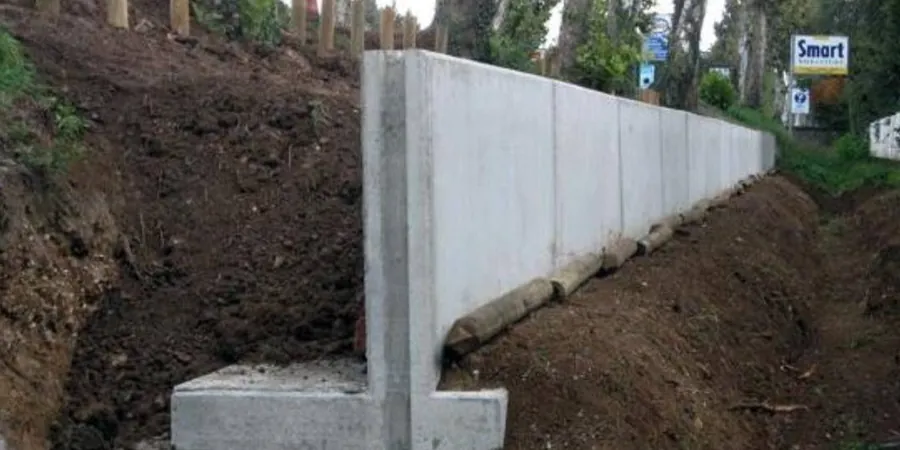
Our retaining wall work in Bath covers everything from small garden terraces to full-height basement retaining on sloping sites. The two core services are:
Permanent Retaining Wall Design
Full design package for reinforced concrete cantilever, gravity, and masonry-faced walls. Includes bearing and sliding checks, global stability analysis, reinforcement detailing, and drainage specification. Suitable for basement boxes, garden terracing, and road embankments across Bath's steep neighbourhoods.
Temporary Works & Excavation Support
Design of temporary earth retention systems for construction-phase excavations. We cover sheet pile walls, king post walls, and soil nail stabilisation where access is tight and adjacent structures are sensitive. Method statements and temporary works checks to BS 5975:2019.
Quick answers
What factors influence the cost of a retaining wall design in Bath?
Design fees for a retaining wall in Bath typically range from £920 to £2,850, depending on the height of the wall, the complexity of the ground conditions, and whether temporary works design is needed. A simple 1.2 m garden wall on level ground with good limestone at foundation level sits at the lower end. A 3.5 m basement retaining wall near the Avon floodplain, requiring sheet pile temporary works and slope stability checks, will be at the upper end.
Do I need planning permission for a retaining wall in Bath?
Planning permission is not normally required for a retaining wall under 1 m high adjacent to a highway, or under 2 m elsewhere, provided it is not within a listed building curtilage or conservation area. In Bath, many properties fall within the conservation area, so it is wise to check with B&NES Council. If the wall is part of a basement or terrace project, it will usually be included in the main planning application.
What ground investigation do you need before designing a retaining wall?
At minimum, we need a window sampler or cable percussive borehole to the depth of at least 1.5 times the wall height below the proposed founding level. This gives us soil description, SPT N-values, and samples for laboratory testing. In Bath, we also look for evidence of solution features in the limestone. A trial pit can help inspect jointing near the surface, and a permeability test is essential where drainage design is critical.